

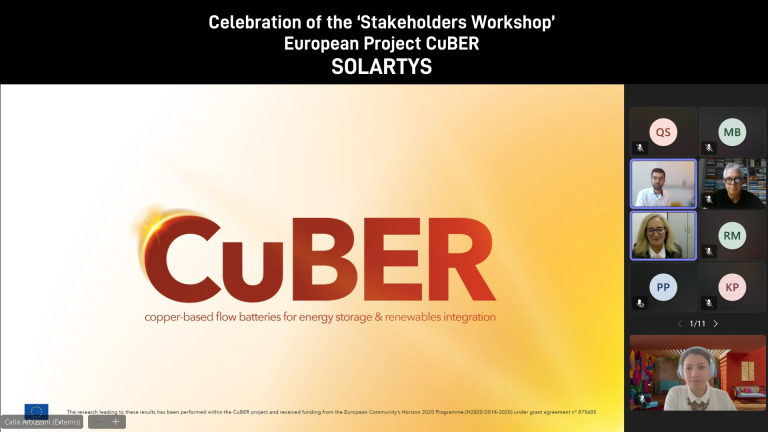
On October 24th, SOLARTYS as part of CuBER consortium, in collaboration with FLORES, Hybris and Melody project, successfully organized the Stakeholders Workshop of the European projects related to redox flow batteries (RFB). An event that brought together over 120 experts from the energy sector, as well as several companies from the sector, to discuss the advances and challenges in battery integration. This workshop, held virtually, stood out for its focus on funding and technological innovations in the field of RFB.
A Challenging Project and Its achievements
The CuBER project has represented a significant challenge since its inception, facing and overcoming multiple technical and logistical challenges. During the workshop, the most notable achievements of previous European projects on flow batteries were presented, with interventions from representatives of twelve different projects. These advances underline the continuous commitment of the scientific and business community to improve the efficiency and energy density of flow batteries.
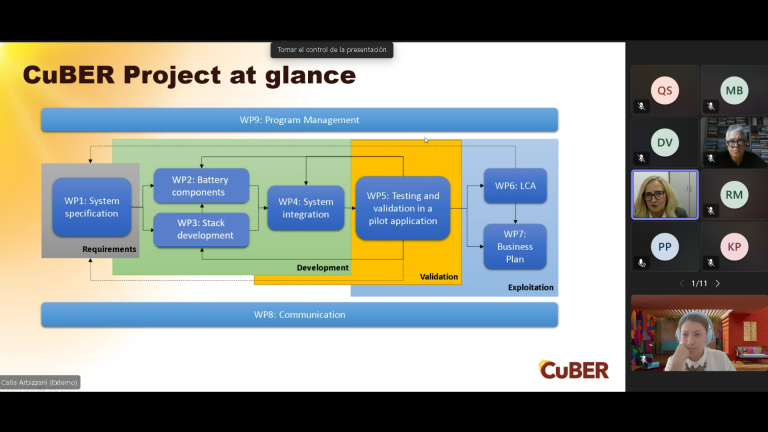
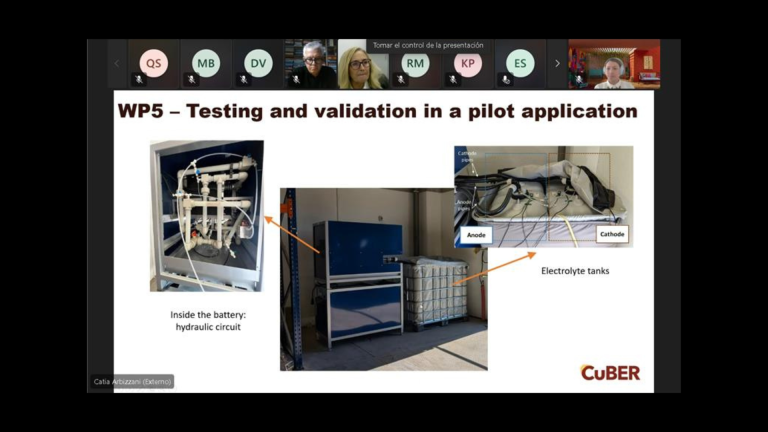
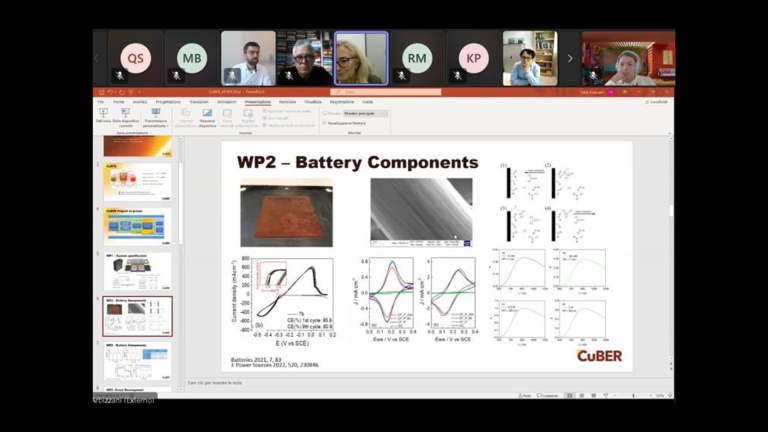
Corneliu Barbu, Coordinator of the CuBER project, introduced the project by covering its general aspects and Catia Arbizzani, representing the CuBER consortium, provided a detailed overview of the project’s achievements and next steps, emphasizing the importance of copper-based flow batteries for energy storage and renewables integration.
Collaboration and EU Participation in the Workshop
This workshop was organized in collaboration with the FLORES, Hybris, Melody, and CuBER projects, which allowed for greater reach and more diverse participation. One of the most anticipated moments of the event was the session on “Funding for Battery Integration,” where the funding instruments available in the Horizon Europe program for topics related to flow batteries were discussed. This session, led by experts from the European Union, provided a detailed overview of funding opportunities and support for innovative projects in this field.
Workshop Agenda
The event was moderated by David A. Vermaas, Associate professor at TU Delft / Transport Phenomena (TP) and conducted with great punctuality, following the agenda below:
- 13:00 – 13:15: Opening
- 13:15 – 14:15: Highlights of current/past EU projects on flow batteries (12 projects with 5 minutes each).
- 14:15 – 14:45: Copper-based flow batteries for energy storage and renewables integration: results and learnings from the CuBER project (Catia Arbizzani, Alma Mater Studiorum – Università di Bologna, CuBER project).
- 14:45 – 15:00: Break
- 15:00 – 15:30: H2-Br2 redox flow batteries (Wiebrand Kout, Elestor, MELODY project).
- 15:30 – 16:00: Energy storage market developments (Jonas Hyllseth Ryen, Business Developer at New Business Development of Statkraft).
- 16:00 – 16:30: Redox-mediated Zn-air flow batteries (Erik Kelder, TU Delft, ReZilient project).
- 16:30 – 16:50: Overview of funding instruments for RFB topics in the Horizon Europe program (Johan Blondelle, policy officer at the European Commission).
- 16:50 – 17:00: Closure.
Participating Companies and Their Analysis
The Stakeholders Workshop of the European project CuBER featured the participation of a wide variety of companies and academic institutions, as stakeholders, their participation can be highlighted to show the diversity and collaboration across different sectors.
For instance:
Academic Institutions: These institutions contribute cutting-edge research and innovative solutions in the field of flow batteries. Their participation ensures that the latest scientific advancements are discussed and integrated into practical applications.
Research Institutes: These organizations bring specialized knowledge and expertise in specific areas of battery technology, providing valuable insights into the technical challenges and potential solutions.
Industry: Companies from the industry sector are crucial for the commercialization and large-scale implementation of battery technologies. Their involvement highlights the practical applications and market developments in the energy storage sector.
Consultancies: These firms offer strategic advice and support for the development and deployment of battery technologies, helping bridge the gap between research and industry.
Public Institutions: The participation of public institutions, such as the European Commission, underscores the importance of policy and funding support for advancing battery technologies and achieving sustainability goals.
This categorization and analysis can ensure that all relevant perspectives are considered, fostering a comprehensive and collaborative approach to addressing the challenges and opportunities in the field of flow batteries.
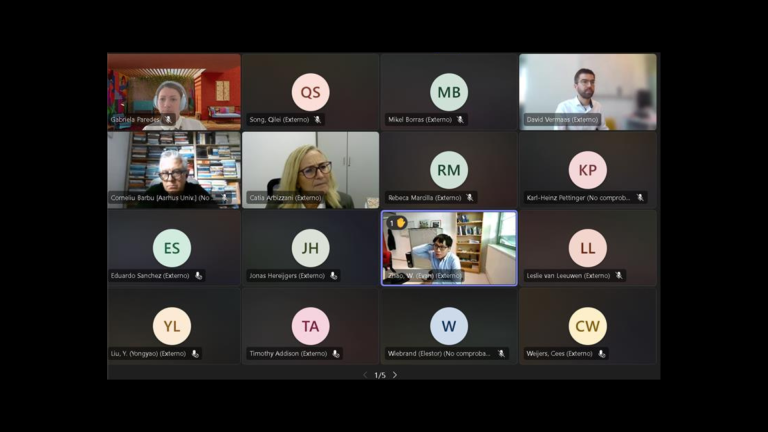
The workshop saw a diverse representation from various countries, highlighting the global interest and collaboration in the field of flow batteries. Notably, there was significant participation from the Netherlands, Belgium, and the UK, along with contributions from Italy, Spain, France, Denmark, China, Portugal, the USA, Switzerland, and Germany. This international presence underscores the widespread commitment to advancing battery technology and fostering innovation across borders.
Conclusion
The workshop concluded with a closing session that summarized the key points discussed and laid the groundwork for future collaborations and projects in the field of flow batteries. The high level of participation and engagement demonstrated the great interest and relevance of this event in the scientific and business community.
